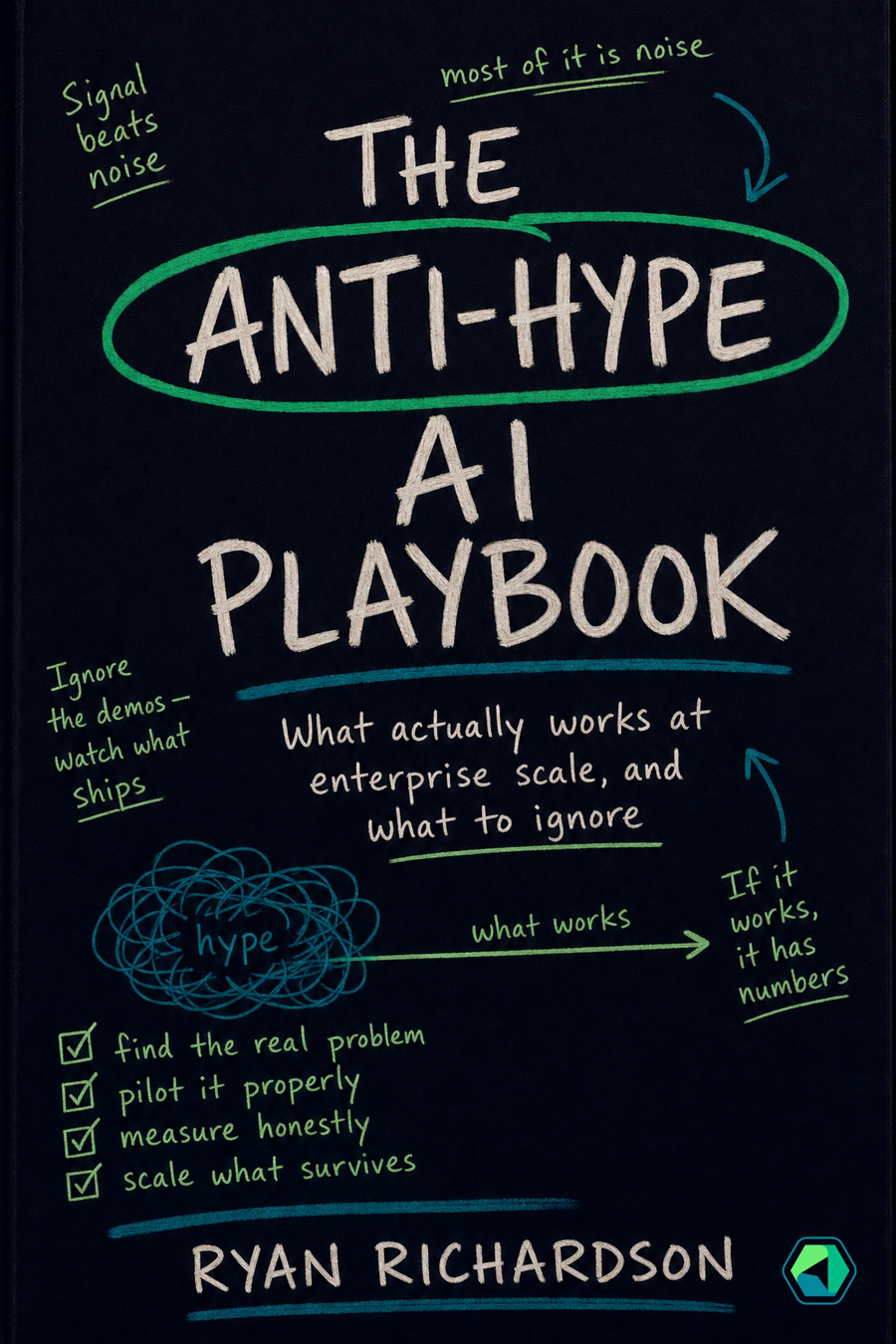
I sell AI work. I am telling you to buy less.
The vendor presents, the invoice clears, and nine months later the pilot is still a pilot. They have been paid and moved on. You are the one who has to sit in front of the person who asked what you were doing about AI and account for it. This book is the homework you would do yourself if you had the time: what survives contact with real data at enterprise scale, what to ignore, and how to tell one from the other before the money moves.
$5. No email required to read this page, nothing to schedule, no call at the end of it. You buy the book, I send the book.
The premise
Most of what you are being told about AI right now is noise. Not wrong in an interesting way. Not early, waiting for the technology to catch up. Noise. Confident, expensive, beautifully formatted noise, sold by people who have never run the thing they are describing on work that matters.
From the introduction.
There is a reason it works. Almost nobody in the room can check an AI claim, so almost any claim sounds plausible. Budget has opened up, so every vendor in the market is reaching for it. The pressure is coming from one floor up, usually as a single question with no good short answer. And the person selling to you carries none of the risk of being wrong. They invoice, they leave, and the decision keeps your name on it.
That is the gap this book is written into. Not whether AI is real, it is, I run my company on it. Whether the specific thing in front of you survives your data, your scale and your auditors, or quietly costs you a year.
What is inside
Every chapter runs the same spine: the claim you are being sold, where it breaks at scale, the pattern that survives, a receipt with numbers from something I actually ran, and one thing to do on Monday. Every chapter ends with two or three questions to put a vendor claim through.
Part I. The Noise
- 1. The Demo–Production Gap. The taxonomy of demo tricks, and the computer-vision product I killed at 50% production accuracy after real investment.
- 2. Vanity Metrics Lie First. A 4% click rate that predicted zero sales, a 23-second page load that turned out to be phantom traffic, and why platforms grade their own homework.
- 3. You Do Not Need an AI Strategy. The 40-page strategy deck is the most reliable sign nothing will ship. What to ask for instead.
Part II. The Patterns
- 4. Automate the Artifact, Not the Job. Pick one recurring output, the Monday pack, the compliance report, and make it produce itself on a schedule.
- 5. The Load-Bearing Test. Automation is real when someone notices within a day if it stops. Everything else is theatre, including the one of mine that failed silently for eight days.
- 6. Trust Nothing, Verify Blind. AI systems report success they did not achieve. What independent verification looks like when the checker cannot see the claims.
- 7. One Owner, Many Agents. Accountability stays human and singular. "The AI decided" is not a sentence an enterprise survives.
- 8. Humans at the Edges. Intent in at the top, exceptions and approvals out at the side, machinery in between. Plus how to pre-authorise the boring 95%.
- 9. The Chassis Rule. Half of any new system is commodity plumbing you should never build twice. Only the last 10% is genuinely new.
- 10. Speed Is a Feature of Small. Why two people embarrass a 40-person program, and why an 18-month AI program is obsolete by design.
Part III. Running the Machine
- 11. Stop Buying Days. How to buy this work: outcomes and artifacts, paid diagnostics before big commitments, a kill gate in every contract.
- 12. Governance That Does Not Strangle. The free-for-all and the freeze, the workable middle, and what a real supply-chain compromise teaches about rotation and blast radius.
- 13. Fewer, Weirder People. The staffing model that works, and how non-technical staff safely run real automated work.
- 14. The First 90 Days. The sequence, in order, week by week, and what it should cost.
Part IV. The Ignore List
- 15. Kill With Dignity. The ignore list by category, and how to write a kill verdict that keeps the learning and the assets.
- 16. The Anti-Hype Test. The whole book compressed into seven questions you can ask out loud, with the owner in the room, before money moves.
Who this is for
- You run something real. A division, a function, a company, with a budget and people attached to it.
- You are not technical, and you have no intention of becoming technical. You need to make good decisions, not write code.
- Someone above you has asked what you are doing about AI, and you would like an answer you can defend in six months.
- You have paid for advice about this before and received slides.
Who this is not for
- Anyone who wants to become technical. This book will not teach you to build it. There are better books for that, and I would rather you bought one of those.
- Anyone who wants predictions about which model wins next year. It makes none.
- Anyone who wants a tour of this season's tools. Tools go stale faster than print.
- Anyone here to evaluate me as a supplier. This is a book, not a pitch. Whether you ever hire me is a separate conversation, and it starts with you asking, not with this page.
Buy the book
The Anti-Hype AI Playbook, $5. PDF, sent to whatever email you use at checkout, usually within a minute.
Three optional add-ons. They are separate pieces of work, not chapters held back from the book. Tick any you want before you pay. If you change your mind after the payment form has loaded, it reloads with the corrected total.
Total: $5
Who I am
I am Ryan Richardson. I run Onwards Analytics, and I run it on this technology: payments, reporting, marketing, support, quality control. My ad account grades itself against the payment ledger overnight. A client's weekly compliance report assembles itself from live data and sends every Thursday at 07:00. I have also killed a machine-learning product that demoed beautifully and topped out at 50% accuracy in production, and I wrote the kill verdict down.
I sell AI work, so some of the money companies spend on this finds its way to me. A cynic could read the book as marketing and would not be entirely wrong. The only answer I have is the sentence the book stands on: I run my company on this stuff, and I am telling you most of what you are hearing is noise. When a vendor believes a bad claim, a client pays for it. When I believe one, I pay for it. That is not a credential. It is a conflict of interest with receipts, which is the closest thing this market has to honesty.